Recently, a team led by BUA's Professor Duan Liusheng published a research paper titled Light-induced m⁶A RNA Modification Regulates Anthocyanin Accumulation during Rose Petal Coloration in Plant Physiology, an internationally renowned academic journal. The paper reveals for the first time the epigenetic transcriptional regulatory mechanism by which light signals mediate light-sensitive rose petal coloration through regulating the dynamic changes of RNA m⁶A methylation. Associate Professor Gao Yuerong and master degree candidate Wang Fengqing from the College of Plant Science and Technology of BUA are co-first authors of the paper, and Professor Duan Liusheng is the corresponding author.
Anthocyanin is a key flavonoid pigment determining plant flower color, with the biosynthesis tightly regulated by environmental signals such as light. Although light is known to activate the expression of anthocyanin biosynthetic genes (e.g., ANS) at the transcriptional level, little is known about whether epigenetic modifications, especially RNA methylation, participate in light-induced flower coloration. m⁶A is one of the most abundant chemical modifications on eukaryotic mRNA and plays multiple roles in RNA metabolism. However, how its regional distribution differentially regulates gene expression, particularly in plants, remains unclear.
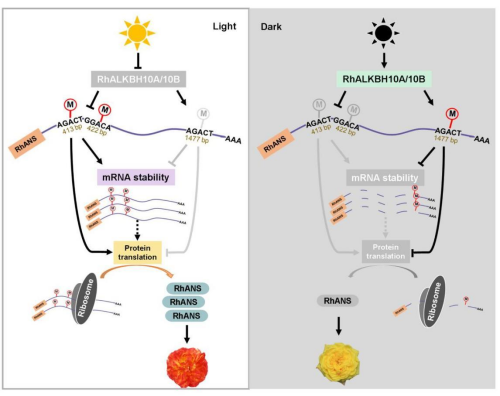
Fig. 1 Molecular model of m⁶A modification regulating anthocyanin accumulation in rose petals under light
Using the light-sensitive rose variety "Spectra" as the material, the research systematically reveals a novel pathway through which light signals regulate rose petal coloration through an epitranscriptional regulation mechanism: Light suppresses the expression of the demethylase gene RhALKBH10A/10B, which in turn regulates the m⁶A modification pattern of RhANS, the key gene for anthocyanin biosynthesis. Specifically, it promotes m⁶A modification in the CDS to enhance mRNA stability and translation efficiency, while reducing m⁶A level in the 3'UTR region to relieve its inhibitory effect. These two effects work synergistically to improve the mRNA stability and translation efficiency of RhANS, ultimately driving anthocyanin accumulation. The research not only reveals for the first time the location dependence of m⁶A modification during light-induced organ coloration in plants, but also provides a new perspective for understanding the m⁶A epitranscriptomic mechanism by which light signals regulate plant organ coloration, and offers potential molecular targets for the improvement of flower color and crop quality.
The research was conducted through the joint efforts of the teachers and students on Professor Duan Liusheng's team and Engineer Zhao Shiwei from the Beijing Academy of Forestry and Landscape Architecture. The project was supported by the Research Laboratory of Molecular Physiology and Chemical Regulation of Groundcover Plants at BUA, and funded by the National Natural Science Foundation of China, the Science and Technology Program of the Beijing Municipal Education Commission, and the Young Teacher Improvement Program of BUA.
BUA will thoroughly study and implement the guiding principles of the Fourth Plenary Session of the 20th CPC Central Committee and the national and municipal education conferences, center around the theme of "making new achievements in the 15th Five-Year Plan period and forging ahead on a new journey", and strive for a robust start in the year with determined actions. BUA will vigorously carry out organized scientific research, pool resources and strengths to tackle major research projects, continuously produce high-level academic achievements, and step up to build itself into a domestically first-class and internationally renowned high-level applied university with urban agriculture and forestry characteristics.

 search


 LATEST NEWS