At the 2024-2025 "BUA Role Models" publicity conference recently held at BUA, Zhu Qiang, a young teacher from the College of Landscape Architecture, and a representative of the "Three Hills and Five Gardens" research team named one of the "BUA Role Models", shared the team's ongoing practices in the cultural exploration, public education, and preservation of Beijing's heritage gardens. The team has successively completed the virtual reconstruction of Changchunyuan (Garden of Exuberant Spring), interpretation of the design theories of Yuanmingyuan (Old Summer Palace), and research on the historical layout of the "Three Hills and Five Gardens", striving to bring the cultural heritage in display to life and make it known to all.
The "Three Hills and Five Gardens" research team is dedicated to the preservation and inheritance of cultural heritage. Over the past decade, the team has focused research on the cluster of imperial gardens from the Qing Dynasty (1644-1911) located in the western suburbs of Beijing, known as the "Three Hills and Five Gardens".
The term may sound unfamiliar to many people. But in the eyes of Zhu Qiang, the "Three Hills and Five Gardens" is a rich mine in the cultural sense. With a perfect integration of ecological wisdom and agricultural water conservancy projects, the garden cluster served as the "sub-center" of politics, culture, and art in Beijing during the Qing Dynasty, and bore witness to the collision between eastern and western civilizations as well as the hardships of the Chinese nation. "The 'Three Hills and Five Gardens' is a unique area in the capital city. Despite the stark differences between its ancient and modern landscapes, it has stood as a living testament to the enduring pulse of Chinese civilization for nearly a millennium, and is an epitome of China's cultural heritage preservation efforts," Zhu Qiang said emotionally.
Over the years, the team has held fast to its original passion. Following the footsteps of pioneers, the team has delved into a vast sea of historical documents, working to communicate the stories of the "Three Hills and Five Gardens" to the public in an easy-to-understand way.
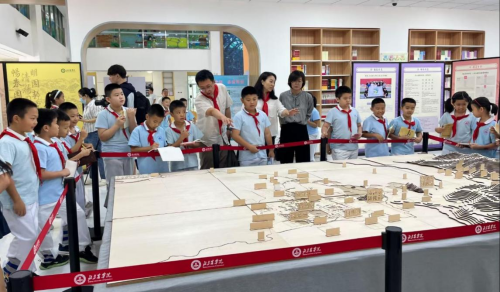
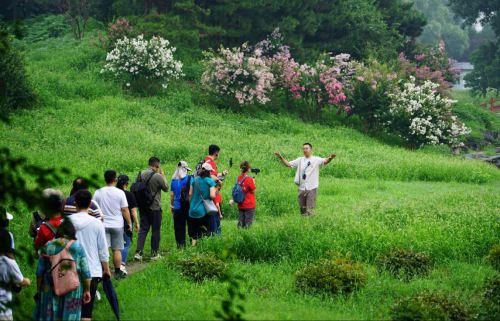
Through meticulous historical research, the team has produced virtual reconstruction of the nearly-lost Changchunyuan, uncovering the ancient concepts of garden design. Also, the team has published three books in the "Joining Today's Garden Tour" series, promoting the scientific interpretation of the "Three Hills and Five Gardens" culture from a holistic perspective; collaborated with the Haidian District Government, the Summer Palace, among other institutions, to curate multiple large-scale exhibitions; developed school-based courses on the "Three Hills and Five Gardens" for primary school students at Beijing Bayi School, and hosted history-themed garden activities for public engagement at Yuanmingyuan. It has been invited to numerous garden culture programs on CCTV and BTV, and successfully completed supporting landscape projects for several key cultural relics sites.
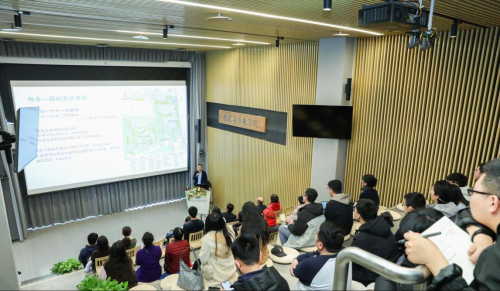
Social recognition has become the force driving the team's progress. Zhu Qiang often hears words like this: "I have never understood gardens so deeply. Thank you!" What has impressed him most was his delivery of speech at the Peking University in March 2025. His reporting on the history and culture of Changchunyuan attracted nearly a hundred teachers and students, and the news was posted in Peking University's official newspaper and WeChat account. The spatial overlap between Peking University's campus and the imperial gardens, and the fascinating interpretation of the reason behind it from historical and cultural perspectives, excited the audience. "Having the chance to share our research achievements in China's top university is an immense honor for me, a landscape architect and a young scholar," said Zhu Qiang. Furthermore, after hearing the lecture, several graduate students even proposed to make the Changchunyuan the focus of their graduation research projects. "At that moment, I experienced the true passion from within," he added.
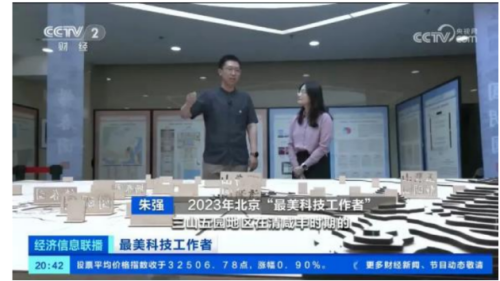
As stated in the award citation for the "2023 Beijing's Most Beautiful Scientific and Technological Workers": "They trace the past and connect the present, impart knowledge and educate people, and make fine traditional Chinese culture deeply rooted in the hearts of the people." Zhu Qiang said, the research on and dissemination of Chinese garden culture have just begun. The team will continue to seek stories in ancient books, carry out practices in ancient gardens, and share Chinese garden culture with more people little by little. "We safeguard not only natural and cultural landscapes, but the very roots of the nation; we foster not just gardens, but the grand vision of a beautiful China and national rejuvenation." Zhu Qiang and his team will continue to press ahead with this passion, steadfast and determined.

 search


 LATEST NEWS