Recently, Yuxuan Zhang, a young faculty member from the College of Intelligent Science and Engineering at Beijing University of Agriculture, serving as the corresponding author, published an online research article titled "Pipeline Posterior Scoring Module for out-of-distribution detection via attachable uncertainty quantification" in Reliability Engineering & System Safety (IF = 13.7), a top-tier international journal in the field of reliability engineering. Addressing the critical issue of overconfident misjudgment by deep learning models when encountering unknown leak types, sensor anomalies, or out-of-distribution samples in complex industrial pipeline monitoring scenarios, this study proposes a Pipeline Posterior Scoring Module (PPSM). Designed as an attachable unit, the PPSM provides a new technical pathway for achieving highly reliable intelligent diagnosis in the structural health monitoring of industrial pipeline networks.
With the continuous expansion of urban water supply, oil and gas transmission, agricultural irrigation, and industrial fluid systems, pipeline leaks pose significant risks of severe safety accidents, resource waste, and environmental pollution. In recent years, deep learning approaches have demonstrated remarkable accuracy in pipeline leak identification. However, most existing models are built upon the closed-world assumption, wherein training is confined solely to known leak types. Consequently, when confronted with unknown leak patterns, sensor drift, intense noise interference, or other out-of-distribution samples in real-world operational environments, these models often produce high-confidence misclassifications. Such overconfidence poses serious threats to the safety and reliability of pipeline monitoring systems. To address this challenge, the research team proposed the PPSM. Without modifying the parameters of existing leak detection models or retraining the backbone network, the PPSM equips deployed models with robust capabilities for out-of-distribution risk identification and uncertainty quantification, enabling a low-cost, minimally intrusive enhancement of reliability for current intelligent pipeline monitoring systems.
The core innovation of this study lies in the integration of multi-layer feature fusion, Bayesian uncertainty modeling, and risk-aware training objectives. The PPSM is designed as an attachable unit compatible with diverse deep neural network architectures, including ResNet101, VGG19, and MobileNetV2. By extracting multi-layer intermediate features from pre-trained models, it fuses multi-scale information ranging from shallow signal textures to deep fault semantics. Furthermore, it outputs the parameters of a Dirichlet distribution to explicitly characterize both epistemic uncertainty and data uncertainty. In terms of training strategy, the team introduced a risk-driven variational inference objective coupled with a noise validation strategy. This shifts the model's focus from merely pursuing classification accuracy to simultaneously enhancing unknown risk awareness, thereby effectively mitigating the overconfidence prevalent in conventional deep learning models when processing out-of-distribution samples.
Experimental results demonstrate that the proposed PPSM exhibits excellent stability and generalization capabilities in both real-world out-of-distribution detection tasks and synthetic sensor fault diagnosis tasks. In real-world out-of-distribution detection experiments, the PPSM consistently achieves an AUROC above 0.88 across both branched and looped pipeline topologies when integrated with three mainstream neural network architectures. Moreover, its false negative rate remains below 0.15 in most scenarios, significantly outperforming conventional uncertainty quantification methods such as Softmax entropy and Monte Carlo Dropout. In synthetic fault detection experiments, the PPSM maintains high detection performance against typical sensor anomalies, including random noise, zero-point offset, and linear drift. More importantly, the PPSM comprises only approximately 263,000 parameters and requires merely around 5 ms per inference pass, underscoring its excellent potential for lightweight deployment in resource-constrained industrial edge monitoring systems.
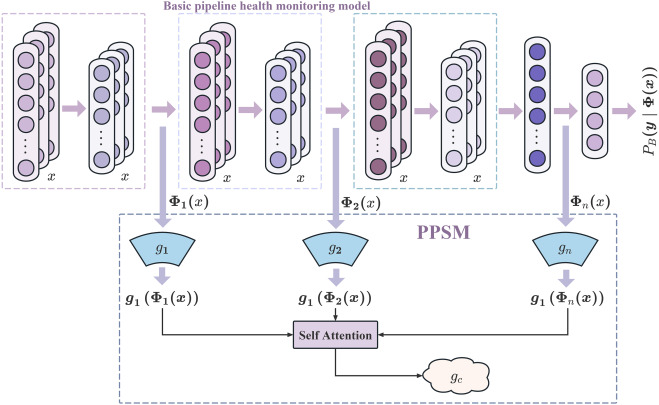
Schematic Diagram of the Pipeline Posterior Scoring Module (PPSM) Method
The corresponding author of the paper is Yuxuan Zhang, a young faculty member from the College of Intelligent Science and Engineering at Beijing University of Agriculture. This work was conducted jointly with partners from Harbin Engineering University, Xi'an Jiaotong University, Tsinghua University, and Mid Sweden University. Furthermore, Professor Yanfu Li from Tsinghua University provided valuable suggestions and academic guidance for this study. This study was supported by the Knowledge Foundation (KK-stiftelsen) through the Next-Generation Industrial IoT and Horizon Europe Technology Transfer Project.
Link to the article: https://doi.org/10.1016/j.ress.2026.113029

 search


 LATEST NEWS