China's livestock industry is currently at a critical stage of transformation, moving from traditional farming practices towards modernization, intensification, sustainability, digitalization, and environmentally harmonious development. Addressing feed resource shortages, reducing carbon emissions from livestock production, and ensuring the safety of animal-derived food products have become pressing challenges for the sector. For many years, natural plant extracts have been regarded as an important pathway for replacing antibiotics and improving animal immunity and production performance due to their safety, environmental friendliness, and multi-target synergistic effects. However, the industry worldwide has long faced challenges arising from the complexity of active compounds, unclear mechanisms of action, and a research and development process heavily dependent on empirical trial and error. These issues have led to unstable product efficacy and protracted development cycles, hindering large-scale commercial application.
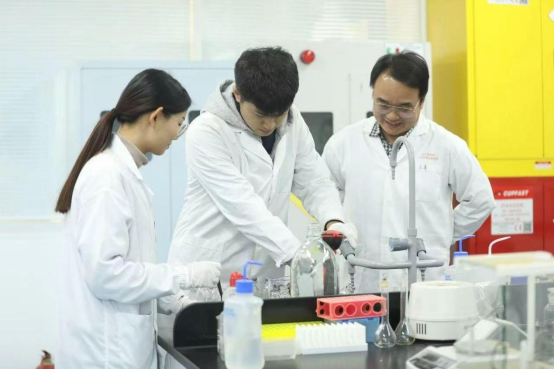
To address these challenges, a joint team led by Professor Jiang Linshu from Beijing University of Agriculture (BUA) and Researcher Zhong Rongzhen from the Northeast Institute of Geography and Agroecology, Chinese Academy of Sciences, has completed over twenty years of systematic research. They have established a pioneering technical framework for feed-grade natural plant active substances, integrating resource digitalization, intelligent screening, product customization, and standardized application. The centrepiece of this framework is the successful development of the Materia Medica Knowledge Hub Large Model (NBCBank-AI) and its supporting system, which serves as the core intelligent engine. This breakthrough fundamentally transforms the previous trial-and-error approach to active substance research and ushers the industry into a new era of precision design and intelligent guidance.
Building upon the theory of Feed Active Substance Omics established by Mr. Lu Dexun, the joint research team innovatively developed three foundational principles, i.e., holism, networking, and interpretability. Using dairy cattle as a model, the team established a core digital infrastructure: the China Feed Natural Plant Active Substance Database (NBCBank). For the first time, the database integrates a five-dimensional framework linking natural plants, active compounds, target molecules, molecular functions, and livestock production outcomes. It systematically consolidates information on 154 plant species, more than 8,000 active compounds, 8,525 molecular targets, and over 58 million structured data records. Notably, over 80 percent of the ruminant-specific molecular interaction data has been cataloged here at a scale unprecedented worldwide. The database clearly reveals the spatial distribution pattern of China's natural plant resources characterized as "two cores, one belt, and three zones" and quantifies regional variation in key active compounds, providing critical scientific support for precise traceability of raw materials and standardized product development.
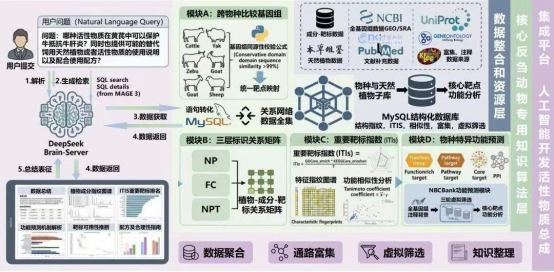
Based on the vast data resources and knowledge graph contained within NBCBank, the team successfully developed the world's first large model dedicated specifically to feed active substances, namely NBCBank-AI. The model overcomes the technical barriers between highly specialized scientific data and natural-language interaction, enabling conversational scientific retrieval and increasing data analysis efficiency by three to five times. More importantly, it achieves a major breakthrough in core algorithms, fundamentally transforming the static association paradigm traditionally used in network pharmacology. Through a cluster of 21 predictive models developed by the team, the system can dynamically infer quantitative relationships across the entire pathway from active compounds to molecular targets and ultimately to biological efficacy. This innovation has boosted efficacy prediction accuracy by more than 80 percent compared to traditional methods, marking a qualitative leap in R&D from empirical trial-and-error to intelligent, algorithm-driven success, thereby drastically accelerating the development process.
The deployment of this intelligent system marks a fundamental paradigm shift in research and development. Utilizing NBCBank-AI, researchers can complete intelligent component screening and formulation optimization within 90 seconds, shortening the overall development cycle to just 12–18 months and elevating the screening success rate to over 75 percent. Guided by model predictions, the research team designed targeted intervention strategies tailored to the physiological requirements of dairy cattle at different production stages. Large-scale validation conducted over three years and involving 15,000 dairy cows at leading enterprises such as Modern Farming and Sunlon Livestock demonstrated a high degree of consistency between model predictions and actual outcomes. For example, during peak lactation, the combined use of grape seed proanthocyanidins and sea buckthorn flavonoids reduced the abundance of ruminal methanogens by 38.5 percent while simultaneously increasing milk fat content. During periods of stress, citrus flavonoids significantly suppressed pro-inflammatory factors and effectively mitigated the adverse effects of heat stress on immune function in dairy cattle.
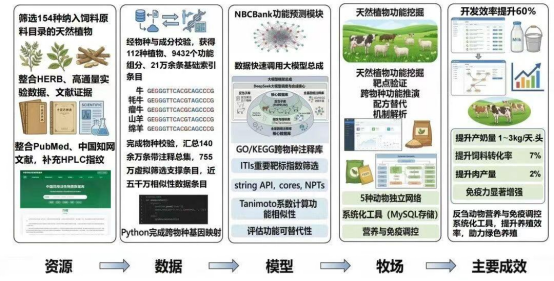
Moving forward, the joint team has successfully formulated 28 functional products across 4 distinct series. Among these, a new product derived from citrus peel extract demonstrated outstanding performance, increasing milk yield by 6.8 percent, feed organic matter digestibility by 9.2 percent, and the proportion of functional fatty acids in milk by 18 percent, while reducing somatic cell counts by 15.3 percent. It also simultaneously enhanced liver function and elevated immunoglobulin levels, delivering a highly favorable input-output ratio of 1:3.5. Its ecological benefits are particularly remarkable: through the synergistic use of specific active substances, it reduced the abundance of rumen methanogens by 38.5 percent, lowering methane emissions per unit by 25.7 percent compared to international benchmarks at equivalent production levels, achieving a perfect alignment of economic and ecological returns. This research received substantial support from the project Integrated Demonstration of Key Technologies for Modern Ranches in Suburban Metropolitan Areas (2023YFD1301800) under the National Key Research and Development Program of China, the Beijing Livestock Innovation Team, and other major initiatives. The outcomes have already been widely adopted across China through an integrated university–enterprise–industry collaboration model.

 search


 LATEST NEWS