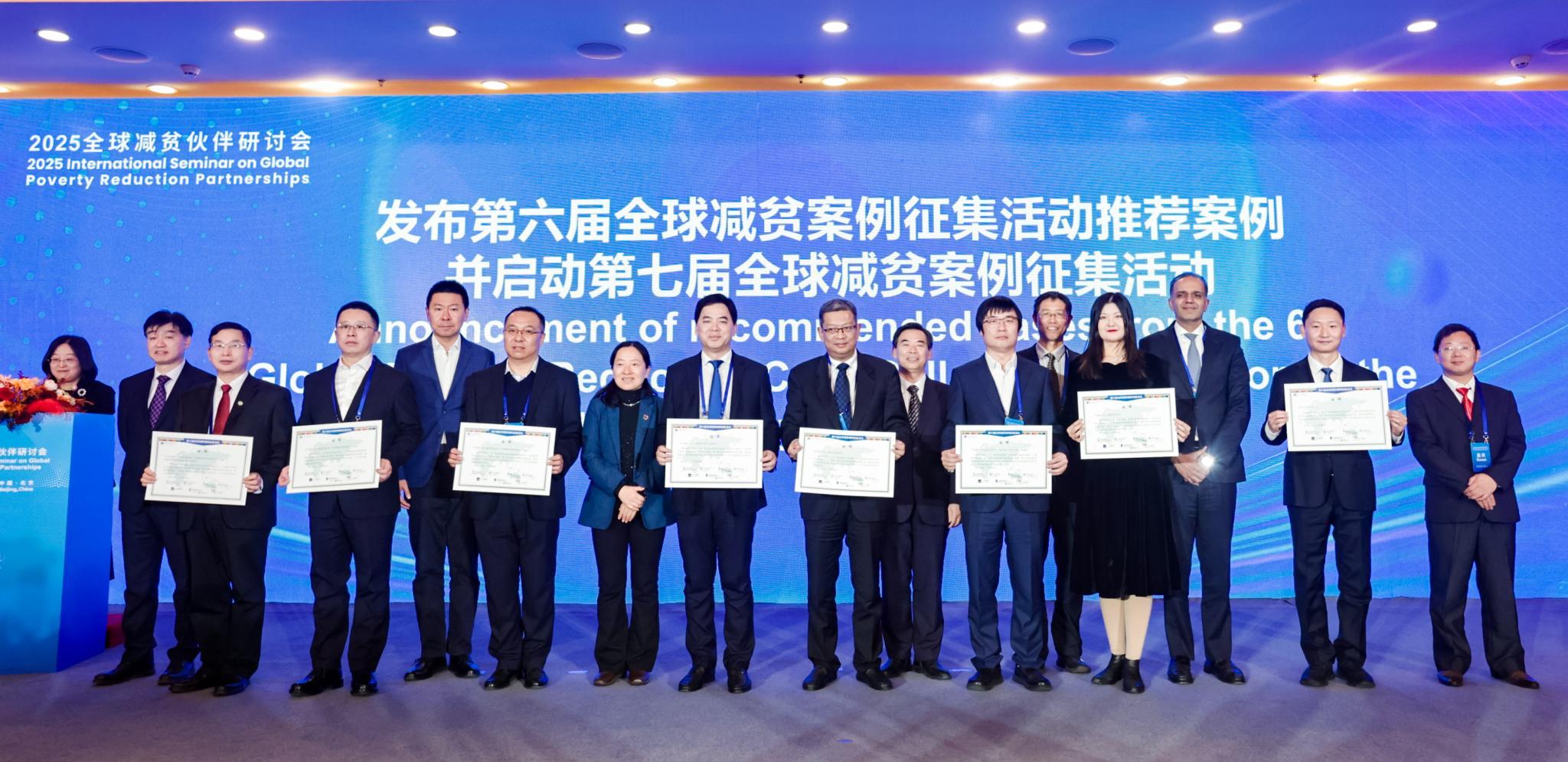
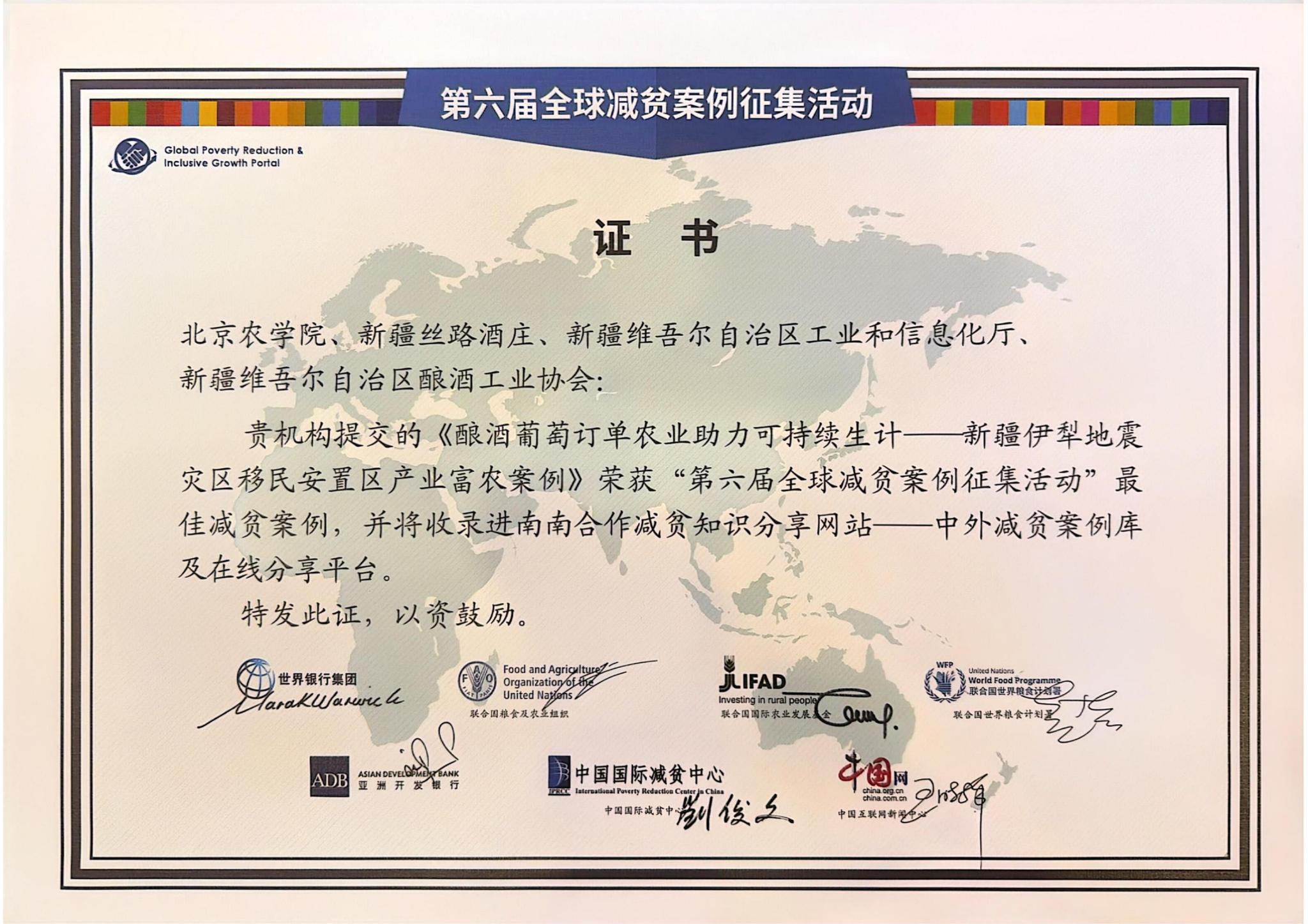
On December 10, the 2025 International Seminar on Global Poverty Reduction Partnershipswas held in Beijing,where the list of best case studies from the 6th Call of the Global Solicitation on Best Poverty Reduction Practices was announced and an award ceremony was held. After joint appraisal by seven institutions, including theInternational Poverty Reduction Center in China(IPRCC),China Internet Information Center(CIIC), World Bank (WB),Food and Agriculture Organization of the United Nations(FAO),United Nations World Food Programme(WFP),International Fund for Agricultural Development(IFAD), andAsian Development Bank(ADB), the case titled "Wine Grape Contract Farming Empowers Sustainable Livelihoods - A Case of Rural Prosperity through Industrial Development in the Relocation Area of the People Affected in Yili Earthquake, Xinjiang", co-submitted by the Beijing University of Agriculture (BUA), Xinjiang Silk Road Vineyards, theDepartment of Industry and Information Technology of the Xinjiang Uygur Autonomous Region, and theWine Making Industry Association of Xinjiang Uygur Autonomous Region, stood out from numerous entries and appeared on the list.This marked the third time that BUA has had a case included into the global top poverty reduction cases, following the inclusions in 2020 and 2022.
In recent years, BUA's grape cultivation & wine industry technology innovation team has focused on the sustainable development of relocated earthquake-affected people. Based on the "Belt and Road" International Institute of Grape and Wine Industry Innovation (the "Innovation Institute"), the team has engaged in collaborations with governments and enterprises, building a "government-industry-university-research-application" ecosystem, forging a wine grape planting industrial chain, and establishing a long-term contract farming model marked by yields control for stable returns. This initiative has helped the relocated people lead a stable and prosperous life through low-risk, stable-return wine grape cultivation, delivering remarkable economic, social, and environmental gains. It has also created a replicable and scalable mechanism linking and benefiting farmers, setting an example for driving ethnic integration and rural revitalization in all respects.
Empowerment with technology: Transition from the yields trap to a higher-quality, better-price model
Back in 2009, the4thDivision ofXinjiang Production and Construction Corpswelcomed 1,300 households from Longnan earthquake-stricken area in Gansu, allocating to them land for wine grape cultivation. But the traditional farming approach soon led them into a "high yield, low quality" trap.Chasing yields alone, farmers overused chemical fertilizers and pesticides, leading to declining grape quality and low purchase prices. As a result, some farmers switched vines to crops or even abandoned farming and headed back home. To ensure fruit quality and cut chemical inputs, rigorous yields control is a must.To address the challenge, BUA'sgrape cultivation & wine industry technology innovation teampooled resources from BUA as well as governments and enterprises to build a "government-industry-university-research-application" collaboration mechanism, with the Xinjiang Silk Road Vineyards as the industrial hub. Together, they launched a contract farming model featuring "yields control for stable returns", shattering the farmers' misconception that "higher yields deliver more profits" and steering them from experience-based farming to science-driven cultivation.
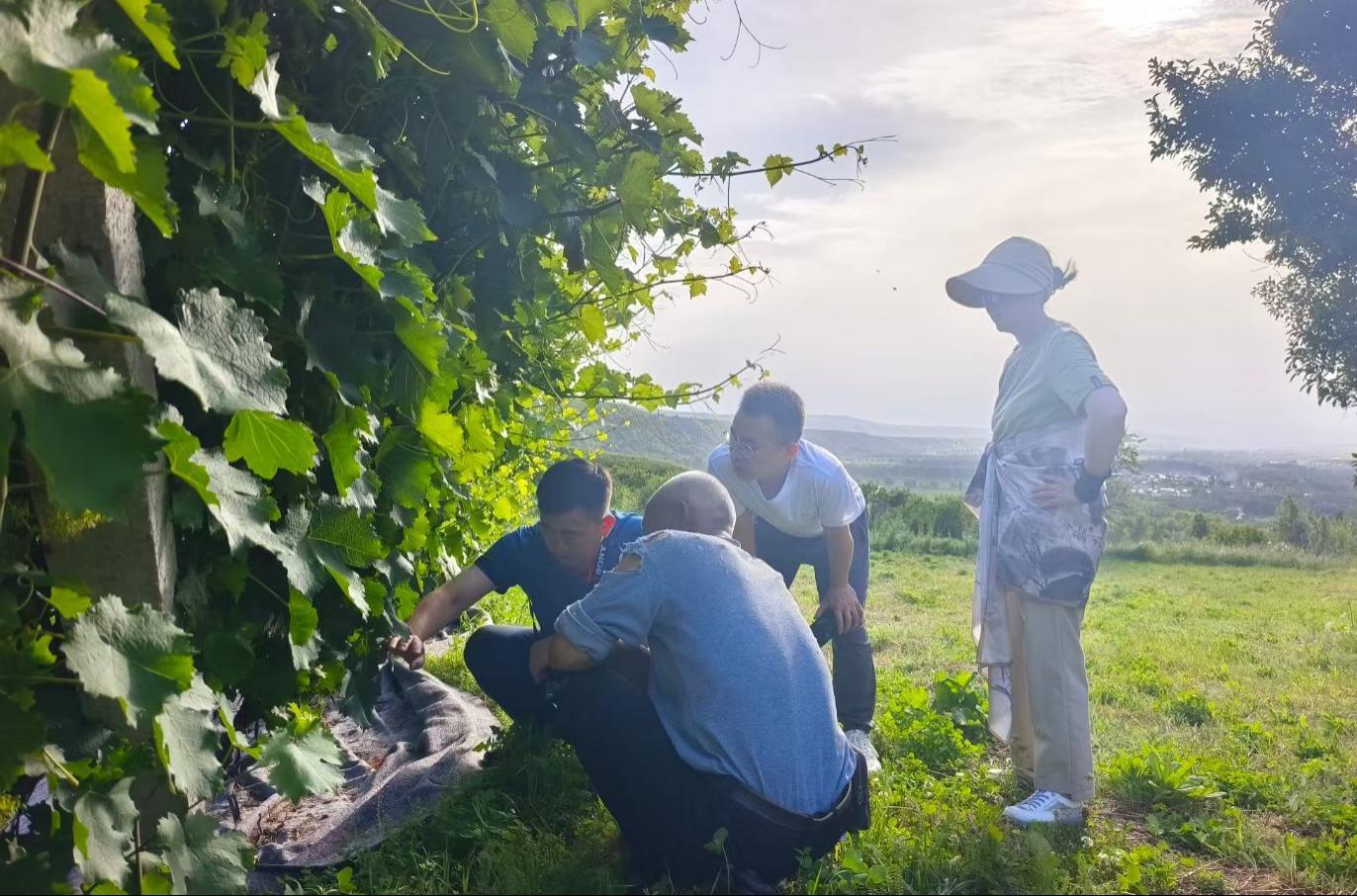
The Innovation Institute provided the farmers with standardized technical support covering every stage of grape growing - from spring vine uncovering, summer field management, and autumn harvesting to winter vine covering.It promoted the alternate high-low volume irrigation method to optimize root system microenvironment and boost water and fertilizer utilization efficiency; it advocated the organic pest and disease control strategy integrating biological control agents and mineral-based pesticides, tailored to the resistance traits of different grape varieties; it dynamically adjusted per-vine fruit load and optimal bunch density based on vine vigor; it optimized planting spacing to improve field ventilation and light exposure and minimize disease risks. These efforts laid a solid technical foundation for elevating wine quality from the source. By limiting yields to 300-600 kg per mu, the initiative has reduced yields while boosting quality, effectively alleviating vine aging and soil fertility degradation and promoting the development of eco-friendly agriculture.
Benefit sharing: The contract farming model guaranteeing minimum output values per mu of field unlocks industrial chain resilience
Technologies cannot be enabled without innovative mechanisms.The Silk Road Vineyards signed agreements with farmers, promising a minimum purchasing price of RMB3,500-3,800 per mu on the condition of a 300-600 kg yield per mu. Moreover, it prepaid for seedling costs that were recovered in installments, eliminating farmers‘ worries about planting risks.In accordance with the per-mu yield control standards, the Innovation Institute formulated an overall technical plan centered on the reversely scheduled planting method. Also, it provided professional support for exploratory and emergent technical issues, and unified technical operation specifications, ensuring the sustainable implementation of contract farming.By joining thiscontract farming program guaranteeing minimum output values per mu of field, the cooperative farmers recorded an annual income soaring to RMB140,000 - 150,000, doubling that under the traditional model. To date, this model has driven the standardized production across 2,000 mu of vineyards and the upgrading of 14,000 mu of bases nearby, benefiting more than 8,000 people of different ethnic groups. The "Silk Road Vineyards Harvest" wine series of the Silk Road Vineyards has won over 100 international awards in total. A sound cycle of "quality materials - brand premium - profit return" has taken shape.
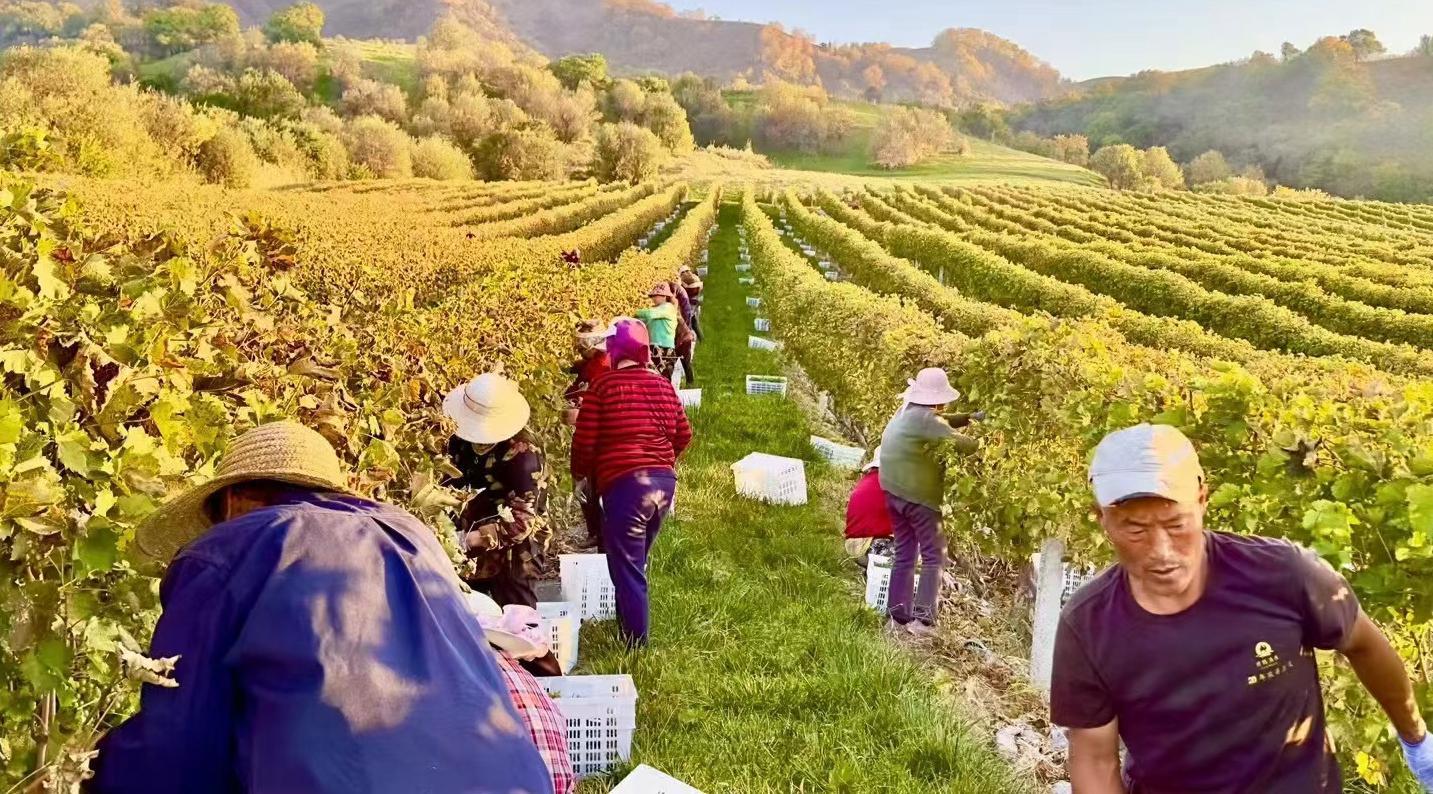
Meanwhile, cooperative farmers have gradually grown into technical backbones by engaging in technical training and standardized production processes. Many relocated people have achieved career transition from farmers to industrial workers, technicians, winemakers, managers and even industry experts. This has further broadened channels for entrepreneurship and employment, enabling them to pursue a happy life powered by fulfilling jobs and common prosperity.
Practice has proved that by forging a link integrating government, industry, university, research and application based on its new-type R&D institute, BUA has driven the improvement of agricultural quality and efficiency through technological empowerment, fostered a consensus on development through benefit sharing, and found an effective path for industrial revitalization in areas with a concentration of relocated disaster-affected people. It has provided a practical model for developing characteristic agriculture that links and benefits farmers, highlighting the big value of a small industry in enhancing people's livelihoods. The Innovation Institute will focus on digital and intelligent planting management, and explore the application of technologies such as IoT monitoring and blockchain traceability, to further improve planting standardization and product credibility. It will focus on extending the ecological chain, and develop by-products such as grape seed oil and pomace fertilizer, to promote circular economy and boost the industry's resistance against risks. Moreover, it will focus on tapping cultural added value by integrating the Silk Road culture and ethnic characteristics to build a wine-themed cultural and tourism IP, and deliver added values across industrial, cultural and ecological dimensions.
BUA will thoroughly study and implement the guiding principles of the Fourth Plenary Session of the 20thCPC Central Committee and Chinese President Xi Jinping's important statements about work related to agriculture, rural areas and farmers. It will continuously unleash its advantages in education, science & technology, and talents, further improve the agricultural science & technology service system, and deepen the integration between technological innovation and industrial innovation. It will constantly enhance its technological innovation capacity and contribution to social services, organize and guide teachers and students to apply their academic achievements to practices across the country and translate research outcomes into tangible gains for farmers. Through the broad practice of comprehensively advancing rural revitalization, BUA will demonstrate its sense of responsibility and contribute more solutions to the global poverty reduction endeavors.

 search


 LATEST NEWS