The 47th World Congress of Vine and Wine and the General Assembly of the Member States of the International Organisation of Vine and Wine (OIV) opened in Yinchuan, Ningxia, on October 12. The congress brought together representatives from 51 OIV member states, diplomatic envoys from 32 countries to China, and more than 800 guests. Held in Asia for the first time, the congress was themed "Shaping new paradigms for the global Vine and Wine sector." Discussions covered four areas: grape growing, winemaking, economics and law, and safety and health, with participants exploring transformation, innovation, and sustainable development in the global vine and wine industry. Professor Li Demei, Associate Professors Pang Xiaona and Zhang Xinke of BUA attended the congress and delivered presentations, sharing their research and exchanging views with international peers on topics including the characteristics of Chinese wine regions, aging techniques, and microorganisms involved in fermentation.
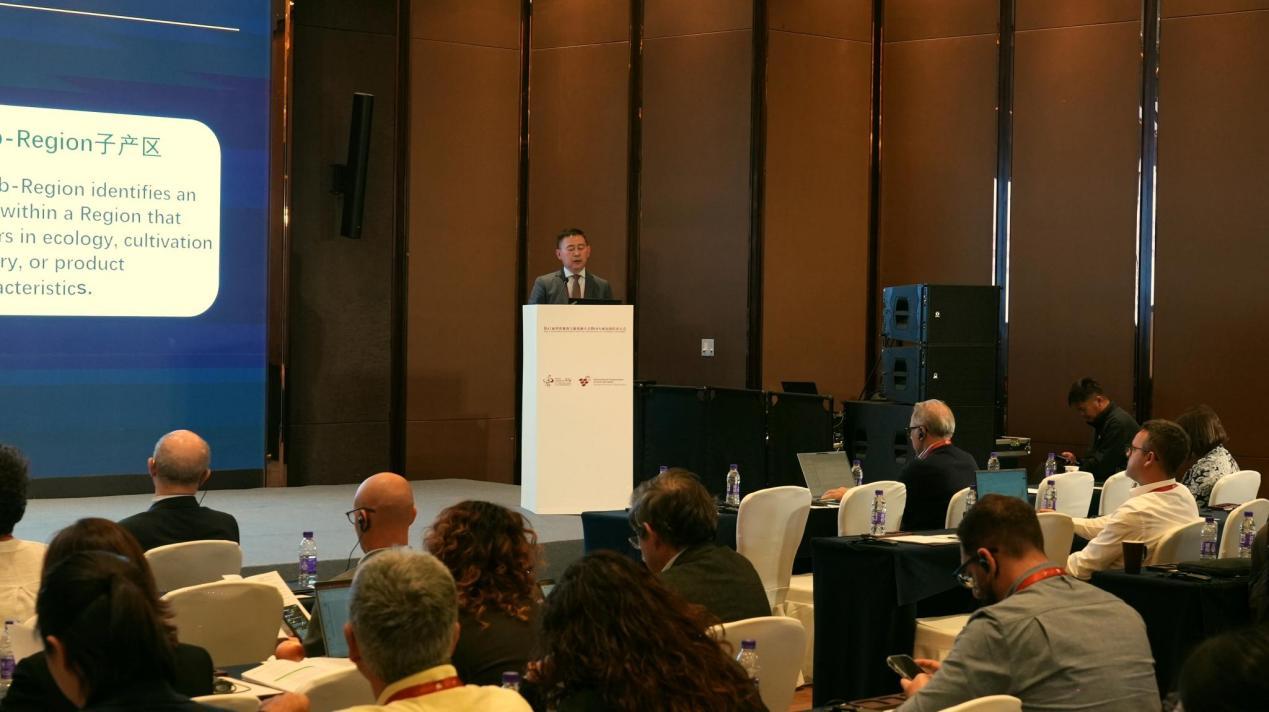
Professor Li Demei delivers presentation.
Professor Li Demei served on the congress presidium and, as a member of the China Technical Committee for Vine and Wine, participated in discussions on proposals submitted to OIV expert commissions. At a technical forum, he delivered a presentation titled Characteristics and Distribution of Wine Regions in China. Focusing on the distinctive features and geographical distribution of China's wine regions, he provided an overview of the country's major wine-producing regions. His presentation highlighted the diversity and regional characteristics of China's wine industry, helping international peers gain a better understanding of Chinese wine regions and providing insights into their terroir, development needs, and industry practices.
Associate Professor Pang Xiaona presented Microbial Diversity during Wine Fermentation in Beijing Region and Its Influence on Wine Flavor, focusing on microbial diversity during wine fermentation in the Beijing region and its effects on wine flavor. Associate Professor Zhang Xinke presented Simulated Oak-Barrel Aging in Ceramic Vessels: Effects on Wine Flavor and Sensory Characteristics, examining the use of ceramic vessels to simulate oak-barrel aging and its effects on wine flavor and sensory characteristics. Focusing respectively on fermentation and aging, the two presentations brought Chinese research and winemaking practices to the international stage. They demonstrated how regionally distinctive techniques can inform wine science and highlighted China's contribution to advances in winemaking technology and the global wine industry.
BUA faculty have conducted research and engaged in academic exchanges on wine regions, winemaking technologies, and policies related to China's participation in the OIV. Their work has addressed the challenges and opportunities arising from the integration of China's wine industry into the international community from the perspectives of industry development, scientific research, and institutional mechanisms. In response to the opportunities created by China's accession to the OIV, the university has brought issues facing the country's wine industry, along with potential solutions, into international discussions. This work reflects the expertise of agricultural universities and their role in supporting industry development and advancing international academic and professional exchange.

 search



 LATEST NEWS
