The 10th Symposium on Urban Modern Agriculture was held at Beijing University of Agriculture (BUA) on October 10. The event was organized by the Urban Agriculture and Leisure Agriculture Branch of the China Association of Agricultural Science Societies (CAASS) and co-organized by the Key Laboratory of Urban Agriculture in North China, Ministry of Agriculture and Rural Affairs, BUA, and Shanghai Jiao Tong University. More than 200 representatives from agricultural universities, research institutes, agricultural management departments, and agriculture-related enterprises across China attended the symposium to discuss the theme of "Digital and Intelligent Technologies for Green Development in Urban Agriculture, Forestry, and Ecology." Among those attending the opening ceremony were Li Tianlai, a member of the Chinese Academy of Engineering and a professor at Shenyang Agricultural University; Wang Cheng, deputy director of the Rural Special Technology Service Center and the Service Center for Enterprise Innovation of the China Association for Science and Technology (CAST), and secretary-general of the China Rural Special Technology Association, CRSTA; and Chen Lianwu, deputy director of the Beijing Municipal Bureau of Agriculture and Rural Affairs. Zhou Pei, director of Key Laboratory of Urban Agriculture (South), Ministry of Agriculture and a distinguished professor at Shanghai Jiao Tong University, presided over the opening ceremony.
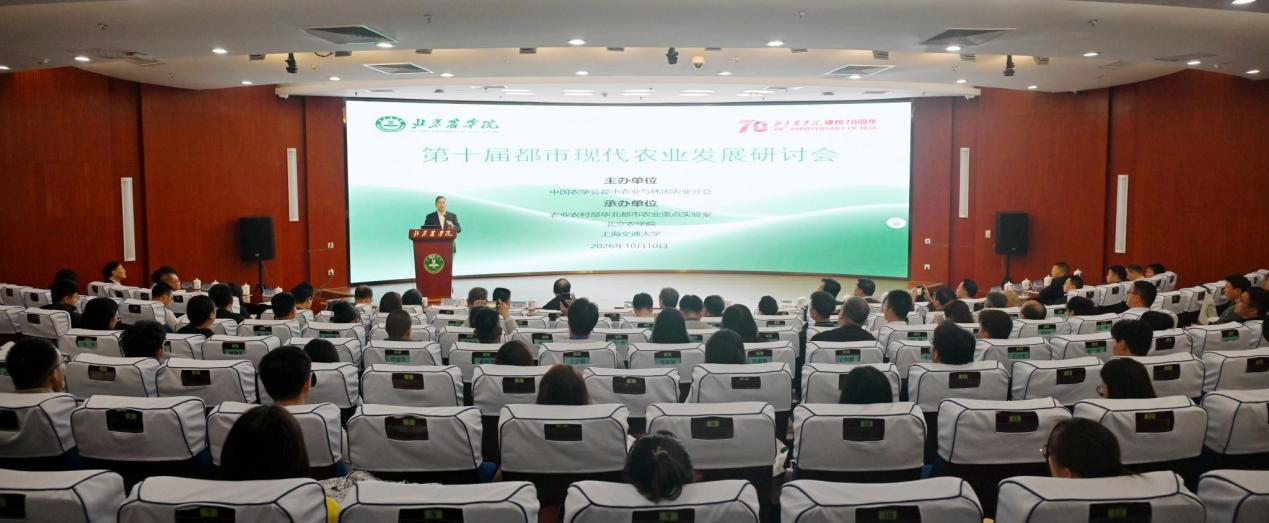
Duan Liusheng, deputy secretary of the CPC Committee of BUA and president of the University, delivered the welcome address. He noted that BUA was the first university in China to propose and put into practice the concept of urban modern agriculture. The University has continued to conduct in-depth research in this field and has achieved substantial results. As BUA marks the 70th anniversary of its founding, it will continue to draw on its academic strengths and disciplinary expertise to support the development of Agricultural Zhongguancun, Beijing's ambition to become a "Seed Industry Capital," and the "Hundred-Village Demonstration & Thousand-Village Revitalization Initiative" (referred to as the "Hundred-Thousand Project"). The University will continue to contribute its expertise to talent development, scientific research, and public service. Duan expressed hope that the symposium would provide an opportunity to deepen collaboration among stakeholders and jointly improve the quality and advance the development of urban modern agriculture, providing scientific, technological, and talent support for Beijing's comprehensive rural revitalization efforts.
Wang Cheng said that CAST would further optimize the distribution of science and technology courtyards serving urban agriculture, expand science and technology volunteer services, establish platforms connecting industry, academia, research, and application, and strengthen the development of local talent. These efforts aim to accelerate the application of scientific and technological advances in urban agriculture. Li Tianlai delivered a keynote address titled "Directions for the Development of Beijing's Modern Protected Horticulture Industry." He analyzed the current state and development trends of protected horticulture in megacities, examined the industry's key constraints, and discussed its future development directions. Zhou Pei presented on the recycling and resource recovery of urban and rural waste. He proposed integrating recycling technologies to foster new quality productive forces in urban modern agriculture. Chen Lianwu outlined the current state of urban agriculture in Beijing and the challenges it faces, reviewed the city's agricultural science and technology innovation initiatives and their contributions to industrial development, and introduced development goals for the 15th Five-Year Plan period (2026–2030).
Huang Lili, a professor at Northwest A&F University, delivered a presentation titled "Plant Protection, Ecosystem Health, and Public Health." Fang Guofei, a researcher at the Center for Biological Disaster Prevention and Control of the National Forestry and Grassland Administration, presented "Reflections and Practices on Advancing 'Artificial Intelligence Plus' for Forestry and Grassland Pest and Disease Management." Wang You'nian, a professor at BUA, delivered a presentation titled "Innovative Practices and Reflections on Urban Agriculture for Green Ecological Functions, Guided by Science, Education, and Culture."
During the thematic discussion sessions, 10 experts held in-depth discussions on agricultural science and technology innovation, green and low-carbon livestock production, technological innovation in the flower industry, integration of agriculture, culture, and tourism, agricultural heritage conservation, germplasm innovation for agritourism, urban-rural integration, the development of industries based on specialty resources, agricultural supply resilience, and the management of land-related ecological risks.
Participants said they would use the symposium as an opportunity to deepen collaborative research and accelerate the application of research findings. They also expressed their commitment to developing urban modern agriculture into a model for agricultural modernization and contributing to comprehensive rural revitalization and China's efforts to become a leading agricultural nation.

 search


 LATEST NEWS