Recently, Zhang Yuxuan, a young teacher, and Professor Qiu Quan from the College of Intelligent Science and Engineering of BUA have jointly published an online research paper, entitled TinyML-Enabled IoT Edge Framework with Knowledge Distillation for Weed Classification, in IEEE Internet of Things Journal (IF=8.9), a top-tier journal in the global Internet of Things field. Focusing on the efficient deployment of weed classification in agricultural IoT scenarios, the research proposes a TinyML edge intelligence framework for ultra-low power devices, providing key technical support for the long-duration and precise operation of agricultural robots.
Amid of the rapid development of smart agriculture, weed classification is a core task for the perception system of agricultural robots, which directly concerns crop yields and resource utilization efficiency. However, conventional deep learning approaches generally rely on high-performance computing platforms such as Jetson or cloud servers, whose high power consumption and heavy computational demands greatly restrict practical deployment on resource-constrained IoT devices. To address this challenge, the research team proposed a TinyML-enabled IoT edge computing framework. By introducing an innovative Three-Dimension Alignment Knowledge Distillation (TDA-KD) method, efficient knowledge transfer from high-precision models to lightweight models is realized. This approach aligns knowledge in three dimensions of individual prediction, sample correlation and semantic relevance. Combined with a multi-temperature soft label mechanism, it can effectively enhance the representational capability and generalization performance of lightweight models.
In terms of model design, the team built a lightweight network structure with multi-scale dilated convolutions. It can capture both local texture and global morphological features with extremely few parameters, thereby solving key challenges in agricultural scenarios, such as similar morphology between weeds and crops and complex field environments. The proposed model achieves a classification accuracy of over 95% across the DeepWeeds and 4Weeds datasets with only 240,000 parameters, apparently outperforming existing lightweight approaches. More importantly, the research enabled the successful deployment of the model on physical embedded platforms. Validated on OpenMV H7 Plus (STM32H7 microcontroller), the model requires only around 105 KB of storage space, with a single inference energy consumption of approximately 510 mJ and an inference time of 375 ms. It delivers ultra-low power operation while maintaining high recognition accuracy. Compared with traditional solutions based on NVIDIA Jetson, the model boosted the overall system operation efficiency by approximately 30.5%, substantially enhancing the continuous working capacity of agricultural robots in wild fields.
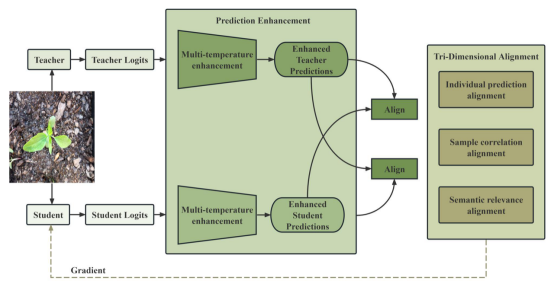
Schematic Diagram of the TinyML-Enabled IoT Edge Weed Classification Framework and the TDA-KD Approach
The research establishes a complete technical chain covering algorithm design, model compression, embedded deployment and system validation, offering a systematic solution for the implementation of edge intelligence models in agricultural IoT. Relevant achievements not only expand the application scope of TinyML in smart agriculture, but also provide valuable references for the application of low-power edge AI to unmanned aerial vehicles, mobile robots and other scenarios.
Zhang Yuxuan, a young teacher of the College of Intelligent Science and Engineering, is the first author of this paper, and Professor Qiu Quan serves as the co-corresponding author. This research was completed in collaboration with domestic and foreign scholars, including Associate Professor Sebastian Bader from Mid Sweden University, Dr Luciano Sebastian Martinez-Rau from the Agriculture and Food Research Center of Australia's Commonwealth Scientific and Industrial Research Organisation, and Professor Brendan O'Flynn from Ireland's Tyndall National Institute. The research was funded by the Young Teachers' Scientific Research and Innovation Capability Improvement Program of BUA and a program launched by the Swedish Knowledge Foundation.

 search


 LATEST NEWS