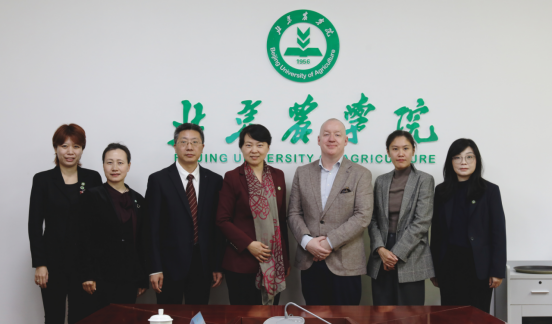
On the morning of April 23, 2026, a delegation headed by Prof. Ken Sloan, President of Harper Adams University in the UK, paid a visit to BUA. Both sides held in-depth exchanges on key topics including the optimization of existing Sino-foreign cooperative education programs and the launch of new "4+0" programs. Wu Yan, Vice President of BUA, attended the meeting, along with relevant heads from the International Cooperation and Exchange Office and the College of International Education.
Wu Yan extended a cordial welcome to the delegation. She noted that the collaborative education initiative between BUA and Harper Adams University has operated smoothly for more than two decades, standing as one of the longest-standing and most fruitful international cooperation initiatives of BUA. The two universities have jointly cultivated over 1,200 high-caliber agricultural talents with a global vision, enjoying a robust foundation for cooperation and solid mutual trust. She expressed hope that through the visit, both sides will expedite the signing of supplementary agreements for current programs, actively advance the planning and application for new "4+0" programs, and pursue higher-level collaboration in talent cultivation, academic exchange and scientific research & innovation, so as to build a benchmark for Sino-UK cooperation in higher agricultural education.
President Ken Sloan thanked BUA for the warm reception and briefed the latest developments and international cooperation initiatives of Harper Adams University. He spoke highly of the two universities' cooperation achievements over the past two decades, noting that both sides are highly aligned in agricultural science, smart agricultural management and other fields, and enjoy broad prospects for future cooperation. He stated that Harper Adams University will fully support the upgrade of existing programs and the development of new programs and further deepen strategic cooperation with BUA, so as to elevate the bilateral cooperation to new heights.
Following the meeting, all participants headed to the College of International Education, conducting discussions on the specific arrangements for cooperative education programs.

 search


 LATEST NEWS